
CEGRAD Fights Child Marriage, Gender Abuse
The Centre for Gender Research, Advocacy and Documentation (CEGRAD), University of Cape Coast (UCC) has held a one-day training workshop on gender-based violence (GBV) and harmful practices…
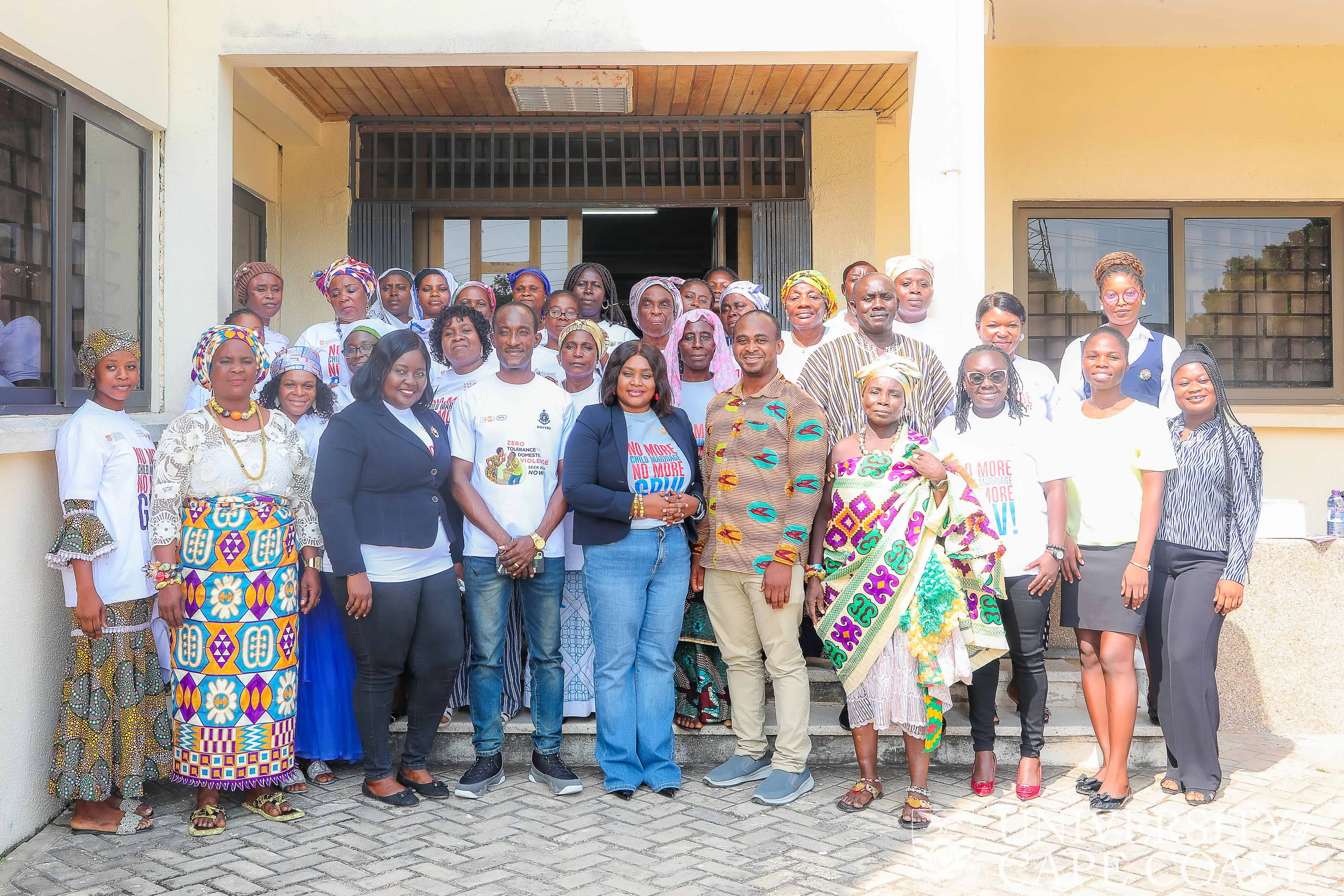
The Centre for Gender Research, Advocacy and Documentation (CEGRAD), University of Cape Coast (UCC) has held a one-day training workshop on gender-based violence (GBV) and harmful practices, including child marriage.
The workshop, “Empowering Women Leaders to Combat Child Marriage, Gender-Based Violence, and Harmful Practices in Selected Communities around the University of Cape Coast,” was supported by the United Nations Population Fund (UNFPA) and the Central Regional Coordinating Council.
The Director of CEGRAD, Prof. Eunice Fey Amissah, stated that the training sought to promote positive attitudes and values regarding gender-related issues.

Prof. Eunice Fey Amissah
She emphasised the importance of recognising and referring abuse cases to appropriate institutions for redress.
Prof. Amissah noted that a national risk review had identified child marriage, exploitation, and the abuse of vulnerable groups—especially women and children—as pressing concerns.
She stressed the need to equip traditional authorities to handle such issues effectively and revitalise traditional institutions as frontline agents of social protection.
She said, “Traditional leaders must move from being passive to active defenders of the vulnerable in their communities.”She emphasised the need for a sustained collaboration with traditional authorities and called for ongoing engagements to deepen awareness and response to GBV in communities.
“This must not be a one-off activity. Continuous engagement with registrars is crucial to fully addressing harmful cultural practices,” she said.
Dr. Yvonne Ami-Adjakloe, Coordinator of Advocacy and Outreach at CEGRAD, speaking on the topic “Empowering Mothers and Mentors,” said the protection of children must be taken seriously to shield them from abuse. She advised pupils to be courageous and report any abuse to security agencies.

Dr. Yvonne Ami-Adjakloe
“The Child Rights Law protects children from all forms of violence and states that the government must do everything to stop underage marriage,” she said.
She disclosed that 20 girls in Ghana marry before the age of 15, with the Central Region bearing the highest incidence of child marriage.
Dr. Ami-Adjakloe highlighted the ramifications of early marriage, including increased vulnerability to sexual and domestic violence, reproductive health complications, psychological trauma, and the perpetuation of poverty due to curtailed education and high school dropout rates.
To address these concerns, she proposed a comprehensive strategy centered on empowering community stakeholders.
She stressed that mothers and community leaders must serve as the first line of defense.
Key actionable steps included financially empowering mothers—since poverty often drives early marriages—and leveraging social media for targeted anti-child-marriage and anti-GBV campaigns.
According to her, there was the need for positive role modelling, consensus-building among traditional and religious leaders, and integrating men and boys into the solution.

Detective Chief Inspector Benjamin Wilson
In his presentation on the topic “Breaking the Cycle,” Detective Chief Inspector Benjamin Wilson of the Domestic Violence and Victim Support Unit (DOVVSU), Cape Coast, stated that child marriage is a violation of human rights and that no tradition can justify the exploitation and harm inflicted on young girls.
He emphasized the legal rights of adolescent girls, citing the 1992 Constitution and the Children’s Act 560 (1998).
He reiterated that no girl should be deprived of her rights and that abusers of the law would face consequences.
He urged young girls to stay informed, seek support, and focus on their education to build a future full of possibilities.

Some residents at the workhop
He maintained that parents remain key in the fight against child marriage, teenage pregnancies, and all forms of sexual and gender-based violence.
He indicated that child marriage remained persistent in some Ghanaian communities, adding that the practice is now often done in secrecy to avoid public criticism.
He also urged parents not to shun their daughters or force them into cohabitation.
At the end of the training, participants demonstrated the knowledge gained and expressed their readiness to engage adolescents within their communities.
Last updated: August 31, 2026
Related News

UCC Shows Gratitude to Retirees
The University of Cape Coast (UCC) has honoured 38 retiring staff members after several years of service to the University.The retirees, who served the UCC between 10 and 42 years, were made up of 20…
UCC Faculty of Law Wins Maiden Ellen a. Awuletey Moot Court Competition
A delegation led by the Dean of the Faculty of Law, Mrs. Julia Selman Ayetey, has presented the Ellen A. Awuletey moot court competition trophy to the Provost of the College of Humanities and Legal…
